
11 Modal Verbs: Important Features, Uses, and 100 Examples
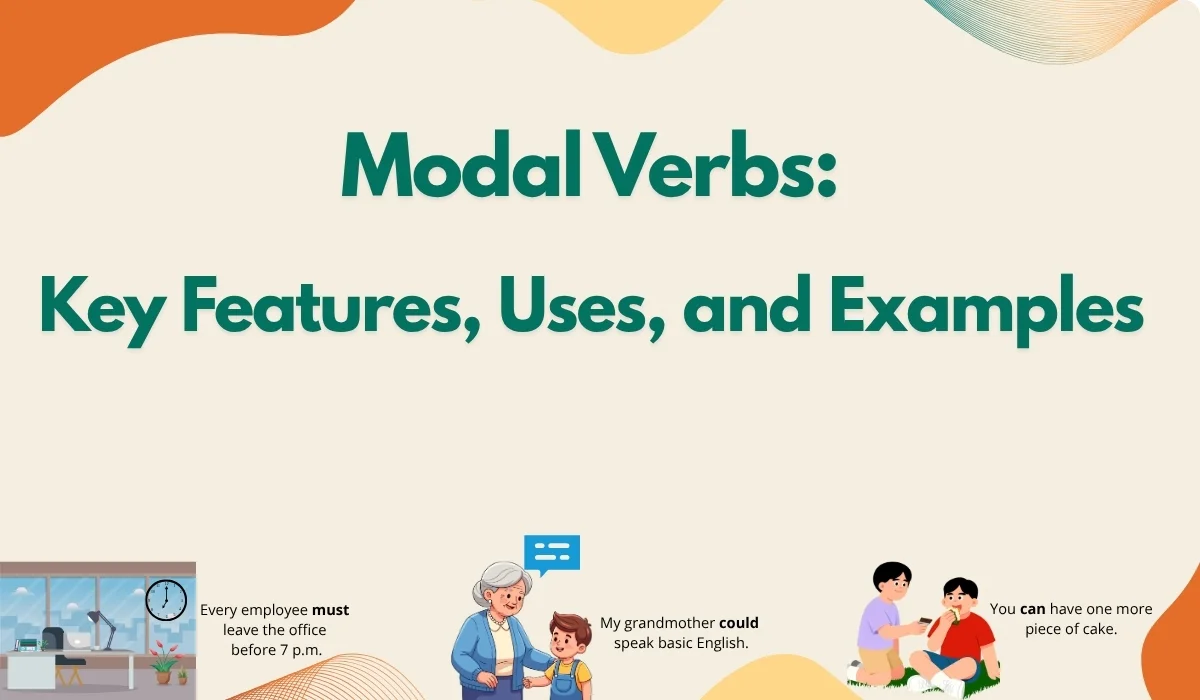
Modal verbs

Introduction Modal verbs are a fundamental part of English grammar. They help speakers express ability, possibility, permission, obligation, advice, and intention. They shape meaning rather than describe actions. Modal verbs are essential for both daily conversations and professional communication.  Learners often face problems in choosing when to use the modal verbs, which one to use … Read more

9 Types of Adverbs: A Detailed Guide with 100 Useful Examples

Types of Adverbs

Introduction We use many sentences as part of our spoken English and written communication. We all know that nouns, pronouns, and verbs play an important role in framing a sentence. Have you ever wondered what makes a sentence feel alive and descriptive? Yes, adjectives and adverbs play a major role in making a sentence clear, … Read more

Active and Passive Voice: A Comprehensive Guide (with 60 Examples)

Active and Passive Voice

Introduction When we want to express our thoughts and ideas effectively, we use a combination of clear thinking and simple language. We can express the same idea in active voice or passive voice. Active and passive voice in a sentence is a fundamental tool in English grammar that determines the relationship between the subject and … Read more

Proper Nouns: Rules, Comprehensive List, and 60 Examples

Proper nouns

Introduction If you want to speak and write English more clearly, then you must understand the proper nouns commonly used in our daily conversations and business English. Nouns are one of the most important parts of speech and writing in English. In nouns, common nouns and proper nouns form a major part of our daily … Read more

4 Uses of Simple Past Tense – Infographic

Uses of simple past tense

Introduction English Grammar infographics present information on important grammar topics and concepts in a concise and visual format. They help learners quickly understand key points without reading lengthy articles. This infographic explains the uses of simple past tense, using simple language and suitable examples. These infographics are especially useful for academic and competitive exam preparation, … Read more

300 Irregular Verbs in Five Forms

Irregular verbs

Introduction Irregular verbs do not follow the standard “-ed” rule when moving into the past tense and past participle forms. Instead, they change their spelling entirely (for example, go – went – gone; speak – spoke – spoken), or sometimes they do not change at all (for example, put – put – put; let – let – let). … Read more

Simple Past Tense: Structure, Rules, Uses, and 100 Examples

Simple Past Tense

Introduction In our daily life, as part of our conversation with others and written communication with others, we talk about things or events that have already happened. In all these conversations and writings, we used the simple past tense. The simple past tense is one of the most commonly used tenses in English. It is … Read more

18 Phrasal Verbs with “Get” with Useful Examples

Phrasal verbs with Get

Introduction You might have been confused when your friends or colleagues used sentences like, “Let’s get together after work”, “I can’t get over how great that meeting went”, or “How are you getting along with the new project?” Don’t worry, you’re not alone. They have used phrasal verbs in those sentences. Phrasal verbs are one … Read more

12 Important Types of Verbs in English

Types of verbs

Introduction Verbs are one of the most important parts of speech in the English language. They are the backbone of any sentence. They act as the engine of every sentence. Without them, communication simply breaks down. Verbs breathe life into your thoughts, ideas and viewpoints, showing action, state of being, and connection. They describe actions, … Read more

Irregular Verb “Speak”: 12 Tenses, Active & Passive Voice 

Irregular verb speak

Introduction We use irregular verbs frequently in our day-to-day English. They form the backbone of everyday conversation and professional communication. These verbs often deviate from the standard “-ed” rule in the past tense. This requires memorization of the unique simple past and past participle forms pertaining to several irregular verbs. Learning irregular verbs is extremely … Read more