
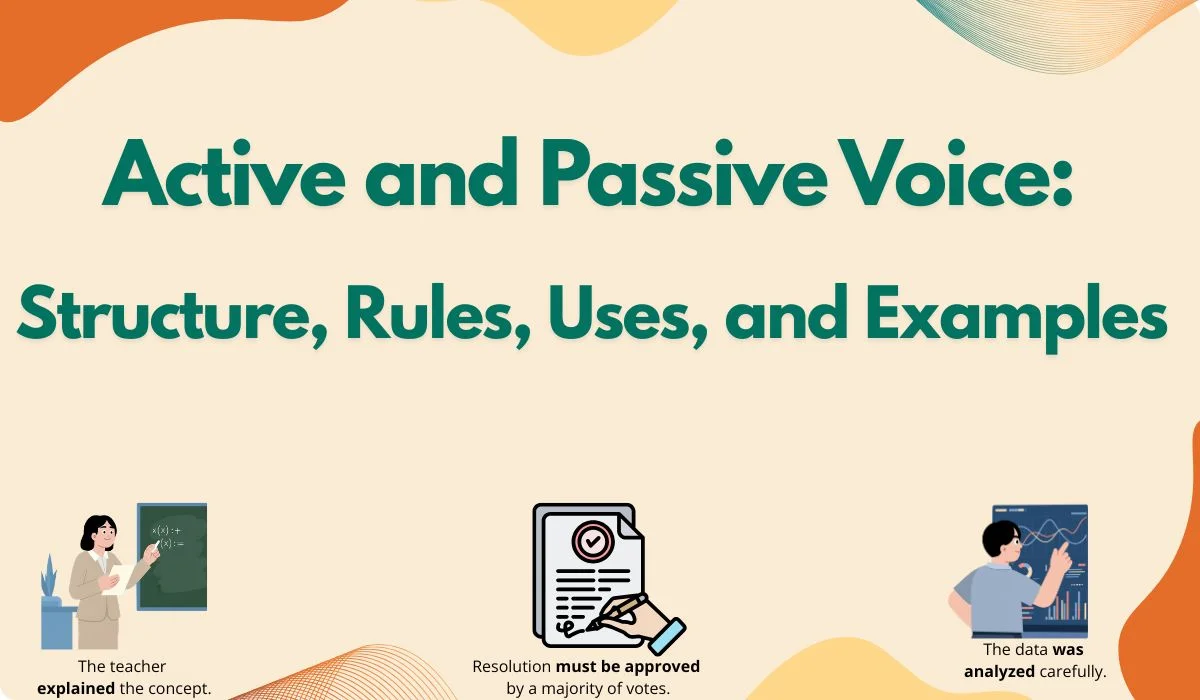
Table of Contents
Introduction
When we want to express our thoughts and ideas effectively, we use a combination of clear thinking and simple language. We can express the same idea in active voice or passive voice. Active and passive voice in a sentence is a fundamental tool in English grammar that determines the relationship between the subject and the action. It determines the focus, clarity, tone, and emphasis in a sentence.
When our focus is on “who” is doing the action, we use active voice. On the other hand, when our focus is on “who” or “what” is receiving the action done by the subject, we use passive voice. To make your writing direct, clear, and easy to understand, use active voice. When the actor is unknown, unimportant, or you want to emphasize the recipient of the action, use passive voice. In passive voice, the focus is on the action itself rather than who is performing it.
In this blog article, you will learn the active and passive voice in detail with a number of examples from different tenses and different contexts. You will learn simple ways to fix your sentences and make your speech and writing direct, clear, and energetic.
What is Active Voice?
We use active voice when the subject is the person or thing that performs the action. You put the “doer” of the action at the beginning of the sentence. This structure makes your writing clear, direct, and easy to read. Readers understand exactly who is doing what.
When you write in active voice, you remove unnecessary words. Your sentences move faster. You keep the reader engaged. Most English sentences naturally use the active voice. Writers prefer it for most types of content, including academic essays, official emails, and blog posts.
Structure of Active Voice
The structure of an active voice sentence follows an order. You start with the subject, follow with the verb, and end with the object.
Structure: Subject + Verb + Object
The subject is the person or thing doing the action. The verb is the action itself. The object is the person or thing receiving the action.
Take this sentence: “The dog bit the postman.” ‘The dog’ is the subject. ‘Bit’ is the verb. ‘The postman’ is the object.
The structure places the most important information right at the front. You know immediately who caused the event.
Rules of Active Voice
Keep the following rules in mind when you speak or write sentences in active voice.
1. Place the Actor before the Action
Identify the person or thing performing the action. Put that noun or pronoun before the verb. Do not bury the actor at the end of the sentence.
Example: She wrote the email. (Active Voice) (pronoun ‘she’ is placed before the verb ‘wrote’)
2. Use Strong Action Verbs
Choose verbs that clearly describe the action. Avoid relying heavily on “to be” verbs like is, am, are, was, and were. Replace weak verbs with strong alternatives.
Example: She wrote the email. (Active Voice) (‘wrote’ is the action verb)
The email was written by her. (Passive Voice) (relied on ‘was’)
3. Keep the Object after the Verb
The person or thing receiving the action must follow the verb directly. This maintains the logical flow of information.
Example: She wrote the email. (Active Voice) (‘the email’ is the thing receiving the action; followed the verb ‘wrote’)
4. Limit Prepositional Phrases
Active sentences rely on clear subjects and objects. Too many prepositional phrases obscure the main action. Frame your sentences to keep the core action visible.
Example: She wrote the email. (Active Voice) (No prepositional phrase)
The email was written by her. (Passive Voice) (‘by her’ is the prepositional phrase)
Uses of Active Voice
Active voice can be used in most situations because it makes communication clear, engaging, and effective. Below are common situations where active voice is preferred.
1. In Daily Conversations
Active voice is natural in spoken English. We very often use the sentences in active voice in our daily conversations and in informal office meetings.

Examples:
- We watched a movie after dinner. (Active Voice)
- He bought a new phone yesterday. (Active Voice)
- They cleaned the house in the morning. (Active Voice)
2. In Informal and Professional Writing
Emails, blogs, and reports are clearer in active voice.
Examples:
- We will complete the task today. (Active Voice)
- I sent you the email this morning. (Active Voice)
- The manager approved the proposal. (Active Voice)
3. When the Doer is Important
If it matters who performed the action, use active voice.
Examples:
- The doctor examined the patient carefully. (Active Voice)
- The teacher explained the concept clearly. (Active Voice)
- The company launched a new product. (Active Voice)
4. To Make Writing Direct and Strong
Active voice reduces wordiness and improves readability.
Examples:
- The team solved the problem quickly. (Active Voice)
- We reject all incomplete applications. (Active Voice)
- The company follows strict safety standards. (Active Voice)
5. In Instructions and Commands
Active voice makes directions easy to follow.
Examples:
- Follow the instructions carefully. (Active Voice)
- Turn off the lights before leaving. (Active Voice)
- Check the details before signing the document. (Active Voice)
What is Passive Voice?
We use passive voice when the subject receives the action or when the subject is affected by the action of the verb. The object of the active sentence becomes the subject of the passive sentence. You place the focus on the result of the action rather than the person who performed it.
We use passive voice when the actor is unknown, unimportant, or obvious. You also use it in scientific or formal writing to maintain an objective tone. However, you should avoid overusing it. Too many passive sentences make your writing sound weak and confusing.
Structure of Passive Voice
The structure of a passive voice is a reversal of the standard word order of “Subject + Verb + Object”. You start with the object of the original action, add a “to be” verb, use a past participle, and optionally include the original subject.
Structure: Object + “to be” Verb + Past Participle + (by + Subject)
Take the earlier active sentence: “The dog bit the postman.”
In passive voice, it becomes: “The postman was bitten by the dog.” ‘The postman’ is the new subject (the original object). ‘Was’ is the “be” form of the verb. ‘Bitten’ is the past participle of the main verb “bite”. ‘By the dog’ is the prepositional phrase indicating the actor.
Rules of Passive Voice
Keep in mind the following rules to form correct passive sentences in your speech and writing.
1. Identify the Object and Move it to the Subject
Identify the object in active and make it as the subject in passive. Identify the object or thing receiving the action in the active voice sentence. Place it at the beginning of the sentence in the passive voice. Make it as the grammatical subject.
Example:
- She wrote the email. (Active Voice)
- The email was written by her. (Passive Voice) (‘the email’ is the object in active, made subject in passive)
Here is a table showing how the pronouns in subject position in active sentences change their form in object position in passive sentences.
Person | Number | Pronouns | |
| Subject | Object | ||
| 1st Person | Singular | I | Me |
| Plural | We | Us | |
| 2nd Person | Singular | You | You |
| Plural | You | You | |
| 3rd Person | Singular | He | Him |
| She | Her | ||
| It | It | ||
| Plural | They | Them | |
2. Use the Correct “Be” Form
You must match the tense of the “be” form of the verb to the tense of the original active voice sentence. If the active sentence is in the past tense, use “was” or “were”. If it is in the present tense, use “is”, “am”, or “are”.
Example:
- She wrote the email. (Active Voice)
- The email was written by her. (Passive Voice) (Sentence is in past tense, hence we used ‘was’)
3. Always Use the Correct Past Participle
The main action verb must change into its past participle form. You change it by adding “-ed” or “-d” for regular verbs. For irregular verbs, you must use the specific past participle form, such as spoken, written, gone, sent, drunk, driven, or eaten.

Example:
- She wrote the email. (Active Voice)
- The email was written by her. (Passive Voice) (‘written’ is the past participle of the verb ‘write’)
For the part participle forms of the commonly used irregular verbs, please read our blog post, 300 Irregular Verbs in English.
4. Add the Actor with a Prepositional Phrase
If you want to include the person who performed the action, add the word “by” followed by the noun or pronoun. You can omit this part if the actor is known to everybody, unknown, or irrelevant.
Example:
- She wrote the email. (Active Voice)
- The email was written by her. (Passive Voice) (‘by her’ is the prepositional phrase)
Uses of Passive Voice
1. When the Doer is Unknown or Unimportant
We use passive voice when we do not know who performed the action. Also, we use it when the doer is unclear, unimportant, or irrelevant to the context.
Examples:
- The reports were stolen yesterday. (Passive Voice)
- In December 2025, a bank in Germany was robbed of valuables worth millions of euros. (Passive Voice)
2. When the Action is More Important than the Doer
We use passive voice when the result or action matters more than who did it. Also, we use it when the focus is on the object being acted upon and not on the subject.
Examples:
- The dish was prepared perfectly. (Passive Voice)
- The rules are strictly followed. (Passive Voice)
3. When the Actor is Known or Obvious
If the doer is obvious, the passive voice allows the focus to remain on the action. Some learners often feel every passive sentence must include “by” + doer. But this is not always correct.
Examples:
- The house has been cleaned. (Passive Voice) (It is obvious that someone in the house cleaned it.)
- The arrangements for the seminar have been done. (Passive Voice) (Participants know who will do the arrangements.)
- The results have been published. (Passive Voice) (We all know a board or university publishes the results.)
4. In Formal, Academic, Scientific and Technical Writing
Passive voice is commonly used in academic and formal writing to maintain an objective and impersonal tone. Passive voice is used to focus on procedures and results rather than the researcher, research analyst, or scientist. It is used to introduce evidence, viewpoint, proposition, argument, or opinion.
Examples:
- The liquid was heated to 120°C. (Passive Voice)
- The economic data was analyzed carefully. (Passive Voice)
5. In Business and Official Communication
Passive voice is used in business contexts to sound professional, neutral, and focused on processes rather than individuals.
Examples:
- The invoice has been approved. (Passive Voice)
- The order has been processed. (Passive Voice)
- A new product was launched for youth. (Passive Voice)
6. In Reports and Minutes of Meetings
When we write reports and minutes of a meeting, we generally use passive voice.
Examples:
- Resolutions must be approved by a majority of at least 60% of the votes. (Passive Voice)
- It was discussed that the delay in holding committee meetings is mainly attributable to prolonged litigations. (Passive Voice)
- It was stated by the Vice President that nine meetings were held during the last quarter of 2025. (Passive Voice)
7. To Sound Polite or Indirect
Passive voice helps avoid blaming individuals and sounds more polite or diplomatic.
Examples:
- An error was made in the calculation. (Passive Voice)
- The deadline was missed. (Passive Voice)
If you want more examples on the uses of passive voice, read our blog post, Key Uses of Passive Voice.
Active and Passive Voice in Different Sentences
Converting active sentences to passive sentences requires a systematic approach. You must alter the sentence structure while maintaining the original verb form and tense.
We have given here a table consisting of some regular and irregular verbs in five forms. It will help you identify the V1, V2, V3, V4, V5 forms of the verbs that we use in active and passive voice formulas and examples.
| Base Form/Present Simple (V1) | Past Simple (V2) | Past Participle (V3) | Present Participle(‘-ing’ form) (V4) | Present Simple (3rd Person Singular)(V5) |
| Speak | Spoke | Spoken | Speaking | Speaks |
| Send | Sent | Sent | Sending | Sends |
| Write | Wrote | Written | Writing | Writes |
| Read | Read | Read | Reading | Reads |
| Prepare | Prepared | Prepared | Preparing | Prepares |
| Conduct | Conducted | Conducted | Conducting | Conducts |
| Deliver | Delivered | Delivered | Delivering | Delivers |
| Finish | Finished | Finished | Finishing | Finishes |
Follow these detailed rules for each tense.
1. Sentences in Simple Present Tense
We use simple present tense for routine actions, universal truths, or facts.
Active Voice Formula: Subject + Present Simple (V1 or V5) + Object
Passive Voice Formula: Object + is/am/are + Past Participle (V3) + by + Subject
Example:
- Manoj writes reports. (Active Voice)
- Reports are written by Manoj. (Passive Voice)
- The store sells branded products. (Active Voice)
- Branded products are sold by the store. (Passive Voice)
2. Sentences in Present Continuous Tense
You use this tense for actions happening right now. When the verb is in the “-ing” form (that is, in continuous tense), we use the word “being” additionally.
Active Voice Formula: Subject + is/am/are + Verb(-ing) (V4) + Object
Passive Voice Formula: Object + is/am/are + being + Past Participle (V3) + by + Subject
Examples:
- My roommate is preparing the meal. (Active Voice)
- The meal is being prepared by my roommate. (Passive Voice)
- The company is conducting interviews. (Active Voice)
- Interviews are being conducted by the company. (Passive Voice)
3. Sentences in Present Perfect Tense
You use this tense for completed actions with relevance to the present time.
Active Voice Formula: Subject + has/have + Past Participle (V3) + Object
Passive Voice Formula: Object + has/have + been + Past Participle (V3) + by + Subject
Examples:
- The team has finished the project. (Active Voice)
- The project has been finished by the team. (Passive Voice)
- We have seen the movie. (Active Voice)
- The movie has been seen by us. (Active Voice)
4. Sentences in Simple Past Tense
You use this tense for actions completed in the past.
Active Voice Formula: Subject + Past Simple (V2) + Object
Passive Voice Formula: Object + was/were + Past Participle (V3) + by + Subject
Examples:
- We watched a movie on Sunday. (Active Voice)
- A movie was watched by us on Sunday. (Passive Voice)
- She completed the project on Friday. (Active Voice)
- The project was completed by her on Friday. (Passive Voice)
5. Sentences in Past Continuous Tense
You use this tense for ongoing actions in the past.
Active Voice Formula: Subject + was/were + Verb(-ing) (V4) + Object
Passive Voice Formula: Object + was/were + being + Past Participle (V3) + by + Subject
Examples:
- The artist was painting a portrait. (Active Voice)
- A portrait was being painted by the artist. (Passive Voice)
- The accountant was sending the invoice. (Active Voice)
- The invoice was being sent by the accountant. (Passive Voice)
6. Sentences in Past Perfect Tense
You use this tense for an action completed before another past action.
Active Voice Formula: Subject + had + Past Participle (V3) + Object
Passive Voice Formula: Object + had + been + Past Participle (V3) + by + Subject
Examples:
- He had spoken French. (Active Voice)
- French had been spoken by him. (Passive Voice)
- She had delivered the presentation. (Active Voice)
- The presentation had been delivered by her. (Passive Voice)
7. Sentences in Simple Future Tense
You use this tense for actions that will happen later.
Active Voice Formula: Subject + will + Base Verb (V1) + Object
Passive Voice Formula: Object + will + be + Past Participle (V3) + by + Subject
Examples:
- The company will hire 50 employees. (Active Voice)
- Fifty employees will be hired by the company. (Passive Voice)
- We will launch a new product next month. (Active Voice)
- A new product will be launched by us next month. (Passive Voice)
8. Sentences in Future Perfect Tense
You use this tense for actions that will be completed by a specific future time.
Active Voice Formula: Subject + will have + Past Participle (V3) + Object
Passive Voice Formula: Object + will have + been + Past Participle (V3) + by + Subject
Examples:
- I will have spoken German by July. (Active Voice)
- German will have been spoken by me by July. (Passive Voice)
- The builder will have completed the house by December. (Active Voice)
- The house will have been completed by the builder by December. (Passive Voice)
Table – Active to Passive Conversion in All Tenses
The following table shows, with an example sentence, how the main verb and helping verbs are modified when we change a sentence from active to passive voice.
| Tense | Active Voice | Passive Voice |
| Simple Present Tense | I speak Hindi. | Hindi is spoken by me. |
| Simple Past Tense | I spoke Hindi. | Hindi was spoken by me. |
| Simple Future Tense | I will speak Hindi. | Hindi will be spoken by me. |
| Present Continuous Tense | I am speaking Hindi. | Hindi is being spoken by me. |
| Past Continuous Tense | I was speaking Hindi. | Hindi was being spoken by me. |
| Future Continuous Tense | I will be speaking Hindi. | Hindi will be being spoken by me. (Rarely used) |
| Present Perfect Tense | I have spoken Hindi. | Hindi has been spoken by me. |
| Past Perfect Tense | I had spoken Hindi. | Hindi had been spoken by me. |
| Future Perfect Tense | I will have spoken Hindi. | Hindi will have been spoken by me. |
| Present Perfect Continuous Tense | I have been speaking Hindi. | <<No passive form>> |
| Past Perfect Continuous Tense | I had been speaking Hindi. | <<No passive form>> |
| Future Perfect Continuous Tense | I will have been speaking Hindi. | <<No passive form>> |
Note: Please note that there are no passive forms for the Present Perfect Continuous Tense, Past Perfect Continuous Tense, and Future Perfect Continuous Tense, as we cannot have “been” and “being” together in a sentence. The passive form for the Future Continuous Tense is never used or rarely used in conversations or written English.
9. Sentences with Modal Verbs
You treat modal verbs like can, could, should, and must similarly to future tense.
Active Voice Formula: Subject + Modal + Base Verb (V1) + Object
Passive Voice Formula: Object + Modal + be + Past Participle (V3) + by + Subject
Examples:
- She can speak four languages. (Active Voice)
- Four languages can be spoken by her. (Passive Voice)
- You must submit the application. (Active Voice)
- The application must be submitted by you. (Passive Voice)
10. Converting Questions into Passive
In spoken English, we ask questions in the active voice only. This is because questions asked in the passive voice look unnatural and non-standard. However, for students writing academic exams or aspirants/candidates appearing for competitive exams, it’s important to know how to convert questions into passive.
Active Voice Formula: Question word + Subject + Present Simple (V1) + Object
Passive Voice Formula: Question word + Object + Past Participle (V3) + by + Subject
A) Yes / No Type Questions
If the question in active starts with “Do” or “Does”, then it changes to “Am”, “Is”, or “Are” in the passive depending upon the subject. If the question in active starts with “Did”, then it changes to “Was” or “Were” in the passive depending upon the subject. If the question in active starts with “Has”, “Have”, “Had”, or modal verbs, they remain the same in the passive.
| Active Voice (Question Word) | Passive Voice (Question Word) |
| Do / Does | Am / Is / Are |
| Did | Was / Were |
| Has / Have | Has / Have |
| Had | Had |
| Modal verb | Modal verb |
Examples:
- Do you speak Hindi? (Active Voice)
- Is Hindi spoken by you? (Passive Voice)
- Did she write the email? (Active Voice)
- Was the email written by her? (Passive Voice)
B) Wh- Type Questions
If the question in active begins with “Why, Where, When, What, or How”, then the “Wh-” part remains unchanged in the passive. The rest of the question will be changed as we do for the Yes / No type questions, depending upon the tense and subject. If the question in active begins with “Who”, then we will add “By” before the “Wh-” part and frame the question in the passive.
Examples:
- When did we complete our course? (Active Voice)
- When was our course completed (by us)? (Passive Voice)
- Where did you buy this phone? (Active Voice)
- Where was this phone bought by you? (Passive Voice)
11. Converting Imperative Sentences (Commands or Requests) into Passive
Imperative sentences are used for commands, orders, requests, advice, instructions, directions, or warnings. They usually start with the base form of the verb. They have an implied subject “you”, which is generally not written or stated. They end with a period or exclamation mark.
In imperative sentences, the subject is usually ignored or understood. In the passive voice, we begin such sentences with “Let … ” or “You are asked…” for commands, instructions, directions, or advice, and with “You are requested … ” for requests.
Examples:
Commands/Orders:
- Close the window. (Active Voice)
- Let the window be closed. (Passive Voice) (or)
- You are asked to close the window. (Passive Voice)
- Send this email. (Active Voice)
- Let the email be sent. (Passive Voice) (or)
- You are asked to send this email. (Passive Voice)
Requests:
- Please pass the salt. (Active Voice)
- You are requested to pass the salt. (Passive Voice)
- Please sit down. (Active Voice)
- You are requested to sit down. (Passive Voice)
Instructions/Directions:
- Preheat the oven to 350 degrees. (Active Voice)
- You are asked to preheat the oven to 350 degrees. (Passive Voice)
- Submit your photos by Friday. (Active Voice)
- You are asked to submit your photos by Friday. (Passive Voice)
Advice:
- Take this medicine twice a day. (Active Voice)
- You are advised to take this medicine twice a day. (Passive Voice)
- Walk every day for 30 minutes for significant health improvements. (Active Voice)
- You are advised to walk every day for 30 minutes for significant health improvements. (Passive Voice)
Warnings:
- Don’t touch that switch! (Active Voice)
- You are warned not to touch that switch. (Passive Voice)
- Don’t turn off your computer! (Active Voice)
- You are warned not to turn off your computer. (Passive Voice)
Invitations:
- Come to my party! (Active Voice)
- You are invited to come to my party. (Passive Voice)
- We invite you to attend the conference on AI. (Active Voice)
- You are invited to attend the conference on AI. (Passive Voice)
12. Converting Sentences with Two Objects into Passive
Sometimes a sentence may have two objects:
- Direct Object – receives the action directly.
- Indirect Object – receives the benefit of the action.
In such a case, the passive voice can be formed in two ways. It depends on whether the speaker wants to give importance to the direct object or indirect object. Let us learn how to convert such sentences into passive voice.

Example:
- Rohan gave Priyanka a novel. (Active Voice) (‘novel’ is direct object; ‘Priyanka’ is indirect object)
- A novel was given by Rohan to Priyanka. (Passive Voice) (with direct object)
- Priyanka was given a novel by Rohan. (Passive Voice) (with indirect object)
- The manager gave the team clear instructions. (Active Voice)
- Clear instructions were given by the manager to the team. (Passive Voice)
- The team was given clear instructions by the manager. (Passive Voice)
Infographic on Active and Passive Voice
This infographic helps you understand how the different types of sentences are converted into passive voice, all at a glace!

Please click on the image for a bigger view.
Active and Passive Voice Examples
Here are some example sentences in both active and passive voice from daily conversations and business English.
Daily Conversations
- I cooked dinner for the family. (Active Voice)
- Dinner was cooked by me for the family. (Passive Voice)
- My brother washed the car yesterday. (Active Voice)
- The car was washed by my brother yesterday. (Passive Voice)
- The teacher graded the final exams. (Active Voice)
- The final exams were graded by the teacher. (Passive Voice)
- We bought three tickets for the movie. (Active Voice)
- Three tickets were bought (by us) for the movie. (Passive Voice)
- The cat chased the mouse across the room. (Active Voice)
- The mouse was chased across the room by the cat. (Passive Voice)
- Please pay the fee by 30th of this month. (Active Voice)
- You are requested to pay the fee by 30th of this month. (Passive Voice)
- People are always criticizing her. (Active Voice)
- She is always being criticized. (Passive Voice)
- Authorities pulled down the old building. (Active Voice)
- The old building was pulled down. (Passive Voice)
- She watches recipe videos on YouTube. (Active Voice)
- Recipe videos are watched by her on YouTube. (Passive Voice)
- She writes a column for a news magazine. (Active Voice)
- A column is written by her for a news magazine. (Passive Voice)
- The mechanic has repaired the dishwasher. (Active Voice)
- The dishwasher has been repaired by the mechanic. (Passive Voice)
- Someone has invented a new type of computer memory. (Active Voice)
- A new type of computer memory has been invented (by someone). (Passive Voice)
- They have formally filed a complaint. (Active Voice)
- A complaint has formally been filed by them. (Passive Voice)
- The mechanic fixed the engine. (Active Voice)
- The engine was fixed by the mechanic. (Passive Voice)
- They played cricket on Saturday. (Active Voice)
- Cricket was played by them on Saturday. (Passive Voice)
- I ordered a dishwasher from an online store. (Active Voice)
- A dishwasher was ordered by me from an online store. (Passive Voice)
- I saw Neha at the mall. (Active Voice)
- Neha was seen by me at the mall. (Passive Voice)
- Kids found some beautiful shells on the beach. (Active Voice)
- Some beautiful shells were found by kids on the beach. (Passive Voice)
- The teacher wrote the answers on the board. (Active Voice)
- The answers were written by the teacher on the board. (Passive Voice)
- Children wrote stories about their pets. (Active Voice)
- Stories about their pets were written by children. (Passive Voice)
- The nurse wrapped a towel around the baby. (Active Voice)
- A towel was wrapped around the baby by the nurse. (Passive Voice)
- Children were playing cricket. (Active Voice)
- Cricket was being played by children. (Passive Voice)
- Do they clean the house? (Active Voice)
- Is the house cleaned by them? (Passive Voice)
- Did you finish the homework? (Active Voice)
- Was the homework finished by you? (Passive Voice)
- Can you drive a car? (Active Voice)
- Can a car be driven by you? (Passive Voice)
- Could you please repeat that? (Active Voice)
- Could that be repeated (by you), please? (Passive Voice)
- Who took my mobile? (Active Voice)
- By whom was my mobile taken? (Passive Voice)
- Who gave him the bike keys? (Active Voice)
- By whom were the bike keys given to him? (Passive Voice)
- Who will teach the students? (Active Voice)
- By whom will the students be taught? (Passive Voice)
- Inform the police about the accident. (Active Voice)
- Let the police be informed about the accident. (Passive Voice)
- Stop talking! (Active Voice)
- You are ordered to stop talking. (Passive Voice)
- Please get me a glass of water. (Active Voice)
- You are requested to get me a glass of water. (Passive Voice)
- We invite you to join us in celebration. (Active Voice)
- You are invited to join us in celebration. (Passive Voice)
- Come to my home for the festival. (Active Voice)
- You are invited to come to my home for the festival. (Passive Voice)
Business English
- The marketing manager approved the new budget. (Active Voice)
- The new budget was approved by the marketing manager. (Passive Voice)
- Our development team launched the software application. (Active Voice)
- The software application was launched by our development team. (Passive Voice)
- We signed the vendor contract on Tuesday. (Active Voice)
- The vendor contract was signed (by us) on Tuesday. (Passive Voice)
- The company increased quarterly sales by 15 percent. (Active Voice)
- Quarterly sales were increased by 15 percent (by the company). (Passive Voice)
- The department director scheduled the strategy meeting. (Active Voice)
- The strategy meeting was scheduled by the department director. (Passive Voice)
- The presenter explained the invention in simple non-technical language. (Active Voice)
- The invention was explained in a simple non-technical language. (Passive Voice)
- They explained the task to him. (Active Voice)
- The task was explained to him. (Passive Voice)
- The company promotes electric vehicles. (Active Voice)
- Electric vehicles are promoted by the company. (Passive Voice)
- Rajesh is attending the HR meeting. (Active Voice)
- The HR meeting is being attended by Rajesh. (Passive Voice)
- They have completed today’s tasks. (Active Voice)
- Today’s tasks have been completed by them. (Passive Voice)
- The research has yielded useful information. (Active Voice)
- Useful information has been yielded by the research. (Passive Voice)
- I installed Windows 11 on my laptop. (Active Voice)
- Windows 11 was installed by me on my laptop. (Passive Voice)
- They signed a deal with an MNC. (Active Voice)
- A deal was signed (by them) with an MNC. (Passive Voice)
- They opened a new branch in Singapore. (Active Voice)
- A new branch was opened by them in Singapore. (Passive Voice)
- We expanded our export business to Dubai. (Active Voice)
- Our export business was expanded by us to Dubai. (Passive Voice)
- We discussed the use of pictures in the text. (Active Voice)
- The use of pictures in the text was discussed (by us). (Passive Voice)
- We will hold the strategy meeting in Mumbai. (Active Voice)
- The strategy meeting will be held (by us) in Mumbai. (Passive Voice)
- Seema will lead the client meeting. (Active Voice)
- The client meeting will be led by Seema. (Passive Voice)
- Have they resolved the issue? (Active Voice)
- Has the issue been resolved by them? (Passive Voice)
- Have you reviewed the proposal? (Active Voice)
- Has the proposal been reviewed by you? (Passive Voice)
- Can he finish the task? (Active Voice)
- Can the task be finished by him? (Passive Voice)
- Did the client approve the design? (Active Voice)
- Was the design approved by the client? (Passive Voice)
- Can the client extend the deadline? (Active Voice)
- Can the deadline be extended by the client? (Passive Voice)
- How does he solve the problem? (Active Voice)
- How is the problem solved by him? (Passive Voice)
- Who wrote this email? (Active Voice)
- By whom was this email written? (Passive Voice)
- Please forward the email to Suresh. (Active Voice)
- You are requested to forward the email to Suresh. (Passive Voice)
Common Errors in Active and Passive Voice
Let’s now look at the common mistakes made by learners in active and passive voice. Many learners make mistakes when writing sentences in the passive voice. You can overcome this by identifying and fixing the common errors as shown below.
1. Changing the Tense During Conversion
Learners often accidentally shift the tense when converting an active sentence to passive. You must keep the time of tense, whether past, present or future, consistent.
Example:
- The dog chased the cat. (Active Voice) (past tense)
- The cat is chased by the dog. (Passive Voice) (present tense) (Incorrect)
- The cat was chased by the dog. (Passive Voice) (past tense) (Correct)
- I speak Hindi. (Active Voice) (present tense)
- Hindi was spoken by me. (Passive Voice) (past tense) (Incorrect)
- Hindi is spoken by me. (Passive Voice) (present tense) (Correct)
- Muthukumar will send the email. (Active Voice) (future tense)
- The email is sent by Muthukumar. (Passive Voice) (present tense) (Incorrect)
- The email will be sent by Muthukumar. (Passive Voice) (future tense) (Correct)
2. Forgetting the “Be” form of the Verb
Sentences in passive voice always require an auxiliary “be” form (is, was, were) of the verb. Learners sometimes drop it, creating a grammatically incorrect sentence in active and passive voice.
Example:
- The report written by the manager. (Incorrect)
- The report was written by the manager. (Correct)
3. Using the Wrong Past Participle
Many verbs are irregular. Writers often use the simple past tense form instead of the past participle form in passive sentences.
Example:
- The water was drank by the runner. (Incorrect)
- The water was drunk by the runner. (Correct)
4. Dangling Modifiers
Dangling modifiers are another significant challenge for learners in active and passive voice. When you use passive voice, we sometimes don’t use the subject. The phrase (at the start of a sentence) does not logically modify any noun or pronoun in the sentence, leaving it “dangling” (hanging freely) without a clear subject. This creates a situation where introductory phrases attach themselves to the wrong noun. Also, it creates confusion to the reader.
Example:
- Walking down the street, the trees were seen. (The trees were not walking). (Incorrect)
- Walking down the street, I saw the trees. (Active voice fixes the dangling modifier). (Correct)
- Having finished the office work, the TV was turned on. (The subject is not clear.) (Incorrect)
- Having finished the office work, Priya turned on the TV. (Priya is the subject.) (Correct)
5. Unnecessary Passive Voice in Business Writing
Business professionals face challenges when framing sentences in active and passive voice. Professionals often use passive voice to sound formal. This usually creates dense, unreadable text. When you think you are not clear, you should switch back to active voice for clear communication.
Example:
- It was decided by the committee that the budget would be reduced by 10 percent. (Passive Voice) (lengthy and unnecessary)
- The committee decided to reduce the budget by 10 percent. (Active Voice) (direct and clear)
6. Mixing Voices in the Same Sentence
Sometimes learners shift the active and passive voice in the same sentence. Shifting between active and passive voice in a single sentence confuses the reader. You should maintain parallel structure.
Example:
- The workers built the wall, and the roof was installed by the contractors. (Mixing active and passive voice in the same sentence) (Incorrect)
- The workers built the wall, and the contractors installed the roof. (Both are in active voice) (Correct)
- The wall was built by the workers, and the roof was installed by the contractors. (Both are in passive voice) (Correct)
Conclusion
Understanding active and passive voice gives you control over your writing. You now have the knowledge, skill, and tools to change your sentences and your writing style. Active voice helps you write clear, direct, and powerful sentences. Passive voice allows you to shift focus to the recipient of an action when necessary. You should use active voice for most situations. Use passive voice sparingly and purposefully. Master the conversion rules of active and passive voice for every tense. Apply these grammar rules to both your daily conversations and your professional business writing to communicate clearly.
Mastering active and passive voice takes practice. Do not worry if you make mistakes in the initial days, but continue to focus on active and passive voice. Start by looking at your recent emails, articles, blog posts, or essays. Look for sentences where you used passive voice or where the subject hides at the end. Flip those sentences around. You will see an immediate improvement in how people read your work. Keep writing and keep editing your sentences. Over a period of time, you master the skill of when to use active voice and when to use passive voice. Your voice and tone in your speech and writing will become stronger and your messages will be harder to ignore.
_________________________________
Disclaimer: The names of individuals mentioned in blog posts, articles, examples, scenarios, case studies, etc., on this blog website are randomly selected for illustrative purposes only. Any resemblance to actual persons, living or deceased, or similarity to real names is purely coincidental and entirely unintentional. Also read the Disclaimer page.