
Table of Contents
Introduction
We use many sentences as part of our spoken English and written communication. We all know that nouns, pronouns, and verbs play an important role in framing a sentence. Have you ever wondered what makes a sentence feel alive and descriptive? Yes, adjectives and adverbs play a major role in making a sentence clear, unambiguous, prescriptive, and descriptive.
Adverbs give us extra information about an action, incident, or description. Knowing how to use adverbs correctly can transform your English communication. In this blog article, we’ll learn about the major types of adverbs in English with simple explanations, real-life conversational examples, and business English sentences you can use right away.
What are Adverbs in English?
An adverb is a word that gives more information about when, where, or how something happens or happened. An adverb modifies a verb, an adjective, or another adverb. It provides additional information on the verb. It tells us when or how often, to what extent or degree, or in what circumstances something happens or happened. Adverbs are incredibly versatile. Mastering them is key to sounding fluent and natural in English.
Examples:
- She ran quickly. (How did she run? Quickly.)
- He arrived yesterday. (When did he arrive? Yesterday.)
- They worked very hard. (To what degree did they work? Very hard.)
- The students answered immediately. (When did they answer? Immediately, without any delay.)
- I didn’t receive the email but it hardly matters now. (When? At the time of speaking.)
Types of Adverbs
There are 9 main types of adverbs. They are:
- Adverbs of Manner
- Adverbs of Degree
- Adverbs of Place
- Adverbs of Time
- Adverbs of Frequency
- Adverbs of Purpose
- Comparative Adverbs
- Superlative Adverbs
- Sentence Adverbs
1. Adverbs of Manner
The adverbs of manner describe how an action is performed. They usually come after the verb or the object in a sentence and often end in -ly (but not always). You use these adverbs when writing performance reviews, cover letters, professional emails, etc. They show how you get things done. These are one of the important types of adverbs.
Common adverbs: quickly, slowly, carefully, loudly, happily, well, badly, hard, fast, beautifully, wonderfully, gracefully, deliberately.
Examples:
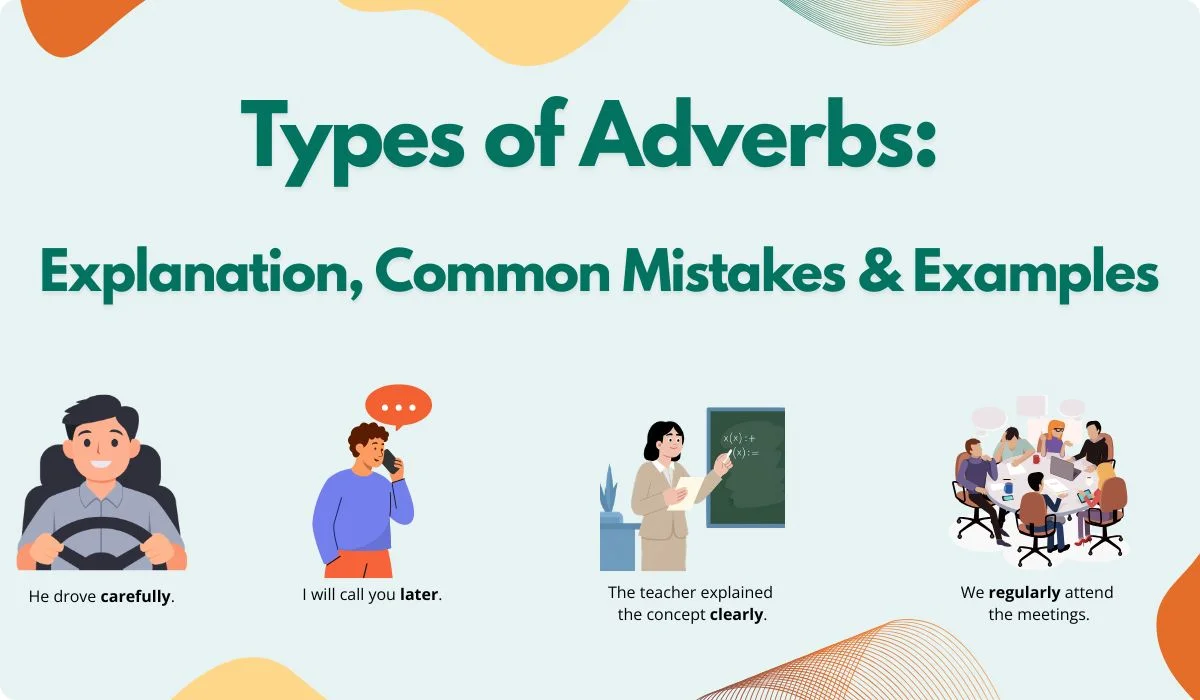
- He drove carefully.
- She replied to my email quickly.
- The baby is sleeping peacefully.
- Students answered the questions correctly.
- The teacher explained the concept clearly.
- The beautiful deer ran gracefully between the shrubs.
- The team has worked hard to complete the project on time.
2. Adverbs of Degree
The adverbs of degree tell us about the intensity or extent of an action, adjective, or another adverb. They answer the question “To what degree?” These adverbs can be placed in front of adjectives or verbs to strengthen or weaken their original meaning. In business writing, replace vague intensifiers like very or really with stronger words like significantly, considerably, or substantially for a more professional tone. These are one of the well-known types of adverbs.
Common adverbs: very, extremely, quite, rather, almost, fairly, slightly, nearly, too, enough, barely, absolutely, significantly, considerably, substantially, badly, completely, deeply, entirely, greatly, largely, perfectly, really, somewhat, totally, utterly, virtually.
Examples:
- I am almost done.
- The coffee is too hot to drink.
- The work is fairly simple.
- This answer is absolutely correct.
- My grandparents’ house in the village is extremely big.
- The two flower bouquets were slightly different from each other.
3. Adverbs of Place
The adverbs of place describe where an action takes place. They usually come after the verb or the object and don’t typically modify adjectives. These are one of the popular types of adverbs.
Common adverbs: here, there, everywhere, nowhere, outside, inside, above, below, nearby, away, north, everywhere, forward, downward, uphill, behind.
Examples:
- Come here quickly.
- Birds are flying above.
- He looked everywhere.
- Children are waiting outside.
- She put her handbag below the table.
4. Adverbs of Time
The adverbs of time tell us when something happens or for how long. They indicate a specific time, a point in time, or a duration. These are one of the important types of adverbs.
Common adverbs: now, then, soon, already, still, yet, recently, today, yesterday, tomorrow, lately, eventually, later.

Examples:
- I will call you later.
- They arrived early.
- I met him last week.
- She will join us soon.
- The train has left just now.
- She finished the work yesterday.
- He has already completed the task.
- We will start the project tomorrow.
5. Adverbs of Purpose
The adverbs of purpose explain why an action is taken. They often appear as phrases introduced by words like to, in order to, so as to, or so that. These are also called ‘adverbs of reason’. These are one of the well-known types of adverbs.
Common adverbs: deliberately, intentionally, accidentally, specifically, purposely.
Examples:
- They deliberately chose this safe policy.
- We should never intentionally hurt anyone.
- The ad campaign is aimed specifically at teenagers.
- He bent down and moved, purposely avoiding the CCTV camera.
6. Adverbs of Frequency
The adverbs of frequency tell us how often something happens. They range from actions that happen all the time to those that almost never occur. In business communication, adverbs of frequency like consistently, regularly, and systematically signal reliability and professionalism. These are one of the popular types of adverbs.
Common adverbs: always, usually, often, sometimes, rarely, seldom, never, frequently, occasionally, daily, weekly, monthly.

Examples:
- They often visit us.
- We rarely watch TV.
- I always wake up early.
- She usually drinks coffee.
- He frequently travels for work.
- They occasionally eat out.
- We regularly attend the meetings.
7. Comparative Adverbs
The comparative adverbs compare the manner, degree, time, or place of two actions. These adverbs are used to compare actions or things or show differences. For short adverbs, we add “-er”, and for longer adverbs, we use “more” or “less” before them. These are one of the popular types of adverbs.
Common adverbs: faster, better, harder, worse, more carefully, more efficiently, more recently, less frequently, more specifically, more slowly.
Examples:
- It is raining worse than ever.
- Could you speak more slowly, please?
- She has been working harder since she got the promotion.
- By following certain steps you can make your PC run faster.
- Christopher speaks English more fluently than other languages.
8. Superlative Adverbs
The superlative adverbs describe an action done to the greatest or least degree among three or more items. Most of the short adverbs take the “-est” suffix, whereas some longer adverbs are used with “most” or “least”. These are one of the important types of adverbs.
Common adverbs: fastest, hardest, best, worst, most carefully, most efficiently, most recently, least frequently.
Examples:
- Their dog jumped the highest.
- The textile industries were hit worst.
- This is the most often prescribed drug for anxiety.
- The documentation was most recently updated in May 2026.
9. Sentence Adverbs
The sentence adverbs modify an entire sentence, often connecting ideas. These are also called ‘conjunctive adverbs’. These are one of the well-known types of adverbs.
Common adverbs: however, meanwhile, certainly, luckily, therefore, consequently, furthermore, apparently, chiefly, interestingly.
Examples:
- Luckily, they found the keys.
- She was not feeling well. However, she went to the office.
- It poses a risk to agriculture and consequently to human health.
- Most small and medium enterprises borrow money chiefly from banks.
- Globally, there is an increase in individuals opting for regular health checkups.
- Certainly, the first 10 months are crucial to a child’s mobility and social interaction.
100 Examples of Adverbs in Sentences
Daily Conversations
- I am extremely tired after the long drive.
- The coffee is too hot to drink right now.
- She is quite good at painting.
- Please write clearly in black ink.
- My new car runs faster than my old one.
- He barely made it to the event on time.
- The movie was absolutely hilarious. I couldn’t stop laughing!
- Let’s sit outside; the weather is perfect today.
- I looked everywhere for my keys but couldn’t find them.
- The kids are playing downstairs.
- Come over here and look at this; you won’t believe it!
- The pharmacy is nearby, just around the corner.
- I’ll call you back; I’m currently in a meeting.
- Have you eaten yet? Dinner is ready!
- She recently moved to a new apartment in the city.
- We should leave now or we’ll miss the train.
- I am still waiting for my Amazon package to arrive.
- I always have a cup of tea before starting my day.
- She sometimes joins us for lunch on Fridays.
- My brother rarely calls; he’s always so busy.
- The kids ran excitedly toward the ice cream truck.
- She spoke softly so she wouldn’t wake the baby.
- Our dog always eats messily!
- She smiled warmly when she saw her old friend.
- We often go hiking on weekends when the weather is nice.
- I never skip breakfast; it’s the most important meal of the day!
- She went to the store specifically to buy ingredients for a birthday cake.
- He left work early intentionally to avoid the traffic rush.
- I called you deliberately before the meeting so you’d be prepared.
- They moved to the suburbs purposely to give their kids a quieter upbringing.
- He accidentally deleted all his photos while clearing storage.
- You need to speak more clearly; I can’t understand you on the phone.
- She carefully folded the letter before putting it in the envelope.
- She arrived earlier than expected and surprised everyone.
- Can you try harder next time? I know you can do better.
- He drives more carefully since his accident last year.
- Among all my siblings, I wake up the earliest every morning.
- She sang the most beautifully of everyone at the school concert.
- Of all the players, he runs the fastest on the field.
- My grandmother cooks the best; nobody beats her biryani!
- He drives the most recklessly in our friends’ group.
- She deftly avoided answering the questions from the media.
- The government has definitely ruled out any immediate policy changes.
- Officials said the data was deliberately withheld during the investigation.
- Agencies are desperately trying to reach affected communities.
- Experts say the crisis must be handled differently this time.
- The minister spoke directly to the public in a televised address.
- The new economic measures have effectively reduced inflation in recent months.
- Emergency teams responded efficiently to the disaster.
- The parents described the incident emotionally during interviews.
- The policy will impact especially the rural areas.
- The report essentially warns about the possible climate risks.
- The interview was aired exclusively on the network.
- The guidelines explicitly prohibit the use of tobacco.
- The issue has been extensively covered by international media.
- Authorities say that the situation remains extremely volatile.
- Fortunately, no casualties were reported after the incident.
- The region is frequently affected by seasonal flooding.
- The proposal would fundamentally change the current system.
- The public has generally supported the new reforms.
- They made a genuinely good attempt to improve conditions.
- The region was heavily impacted by overnight rainfall, authorities said.
- Officials say the new policy will hopefully ease economic pressure.
- Emergency services were immediately dispatched to the scene.
- Experts warn that the issue is increasingly affecting urban populations.
- The rescue operation was described as incredibly complex.
- The plan was initially approved by local authorities last year.
- Naturally, concerns have been raised about long-term safety.
- The changes do not necessarily guarantee immediate results.
- The leader deftly won a power struggle with members of the coalition.
- The airport, which is normally busy, remained closed for hours.
- The risks are obviously higher in conflict zones, analysts say.
- The area is occasionally affected by minor earthquakes.
- The project was originally designed to last five years.
- The measures will affect small businesses particularly hard.
- Officials said the system was perfectly safe under normal conditions.
- The situation is evolving rapidly, according to reports.
- The government has recently introduced new regulations.
- The agency regularly monitors environmental conditions in the region.
- The impact has been relatively limited so far.
- Authorities are taking the threat seriously.
- The reforms have significantly improved public services.
- Similarly, neighboring countries have adopted comparable measures.
- The minister said the decision was simply unavoidable.
- Temperatures have risen slightly compared to last week.
- Recovery efforts are progressing slowly in affected areas.
- This decision will surely have long-term consequences, analysts say.
- The area was totally evacuated as a precaution.
- Such events typically occur during the monsoon season.
- The talks ultimately failed to produce an agreement.
- Unfortunately, several flights were canceled due to bad weather.
- The region usually experiences mild winters.
- The findings have been widely reported across international media.
- Leaders have strongly condemned the attack.
- The mission was successfully completed earlier today.
Business English
- The project manager efficiently allocated tasks to every team member.
- Our customer support team responds promptly to all client queries.
- The CEO confidently presented the company’s five-year growth plan.
- The team collaboratively worked through the product launch challenges.
- Please review the contract thoroughly before signing it.
- The new software update is extremely important for data security.
- Our team is highly skilled in cross-functional project management.
- The quarterly results were rather disappointing compared to last year.
- The client is fully satisfied with the deliverables we submitted.
- We are nearly at capacity and need to expand our operations.
- The new branch office will be located centrally to serve all clients better.
- Our support team is available online 24/7 to assist customers worldwide.
- Please submit your documents here at the front desk before 5 p.m.
- The management team gathered downstairs for the emergency board meeting.
- We ship our products globally, reaching over 50 countries.
- The annual report must be submitted promptly by the end of this quarter.
- We recently onboarded three major clients from the healthcare sector.
- The system upgrade will be completed shortly; please wait.
- The negotiations eventually led to an agreement.
- When is she coming back to work?
- Secondly, the report highlights concerns over funding gaps.
- The market reacted suddenly to the unexpected announcement.
- Our team has already resolved the critical bugs reported last week.
- The board will eventually approve the merger after the due diligence process.
- Our team regularly reviews KPIs to ensure we stay on track with our goals.
- The finance department frequently audits expense reports for compliance.
- Clients occasionally request custom features outside our standard package.
- We consistently meet our delivery deadlines; that’s our competitive edge.
- The leadership team quarterly evaluates individual performance metrics.
- We designed this onboarding program specifically to reduce new employee turnover.
- The company intentionally priced its product lower to capture a larger market share.
- She deliberately scheduled the follow-up call to coincide with the client’s free window.
- The marketing team created this campaign purposely to target millennial consumers.
- Our team strategically timed the product launch to align with the holiday season.
- The new software processes data more efficiently than the legacy system.
- This quarter, our sales team performed better than the previous quarter.
- We need to respond to client complaints more promptly to improve satisfaction scores.
- The revised strategy generated results more quickly than our initial projections.
- The updated process runs more smoothly, significantly reducing operational errors.
- This branch performs the most consistently across all company locations.
- Among our competitors, we respond to market changes most rapidly.
- The company report focuses specifically on climate-related risks.
- Company vehicles should be clearly identified with brand names.
- Bank loans are heavily utilized for working capital and purchasing machinery.
- Of all the candidates, she presented most confidently during the interview.
- The R&D team works most innovatively when given the freedom to self-organize.
- Our flagship product sells most successfully in the Southeast Asian market.
Comparison Table
Here’s a quick recap of all the types of adverbs we covered:
| Type | Answers | Example |
| Manner | How? | She spoke confidently. |
| Degree | How much? | He is extremely talented. |
| Place | Where? | The files are stored here. |
| Time | When? | Submit the report today. |
| Frequency | How often? | We always meet on Mondays. |
| Purpose | Why? | She trained specifically to lead a team. |
| Comparative | More than or less than? | He works harder than before. |
| Superlative | The most or the least? | She performs the best. |
Common Errors in the Use of Adverbs
From my editing experience, I have observed that most of the learners do mistakes in the following:
1. Misplacement of Adverbs
Adverbs can be placed at the beginning, in the middle, or at the end of a sentence. Based on the context and type of adverb, decide the placement and use it correctly. The front position is often used for time or emphasis adverbs. The mid position is common for adverbs of frequency (always, often) and degree (quite, really). The end position is the standard for adverbs of manner, place, and time. Remember the types of adverbs and their usage.
Examples:
- He quickly runs always. (Incorrect)
- He always runs quickly. (Correct)
- He slowly drives. (Incorrect)
- He drives slowly. (Correct)
- She speaks clearly English (Incorrect)
- She speaks English clearly. (Correct)
2. Double Adverbs
When we use the adverbs that indicate high importance or extreme degree, we need not use “very” again.
Examples:
- This is very extremely important. (Incorrect)
- This is extremely important. (Correct)
- It is very vitally important. (Incorrect)
- It is vitally important. (Correct)
- This is very crucially important. (Incorrect)
- This is crucially important. (Correct)
3. Wrong Form of Adverbs
You have to use the correct form of an adverb. Please check whether you are using an adjective or adverb, and use it clearly in your speech or writing.
Examples:
- She sings beautiful. (Incorrect)
- She sings beautifully. (Correct)
- Cook on a low flame for 10 minutes, stirring occasional. (Incorrect)
- Cook on a low flame for 10 minutes, stirring occasionally. (Correct)
4. Over Use of ‘-ly’ Ending
Please remember that not all adverbs are created by adding ‘-ly’ to the corresponding adjective. There are exceptions to this rule. Some adverbs may not have ‘-ly’ endings. For example, alike, downtown, extra, far, fast, inside, long, next, outside, overseas, straight, etc.
Examples:
- The restaurant is not far from here.
- He went inside to get the car keys.
- She was working overseas for a healthcare company.
5. Adverbs with Two Forms
There may be two adverb forms for one word. These two adverbs are related to the same adjective. For example, clear-clearly, close-closely, deep-deeply, easy-easily, fine-finely, hard-hardly, high-highly, tight-tightly, etc. Based on the context, you have to use the correct adverb.
Examples:
- She has been working hard today. (=with great effort)
- We hardly ever go to music concerts. (=almost not)
- My PC is working fine. (=good enough; in an acceptable way)
- The powder consists of finely chopped herbs. (=into very small pieces)
Conclusion
Adverbs are the secret sauce of great English communication. They add precision, energy, and clarity to everything you say and write. From describing how something is done (manner) to explaining why it’s done (purpose), each type of adverb plays its own unique role in making your language more powerful and persuasive.
Whether you are a college student brushing up for exams, a working professional crafting business emails, or just someone who wants to sound more fluent in English, mastering the types of adverbs will take your language skills to the next level.
Keep practicing, keep writing, and most importantly, keep speaking!
FAQs on Adverbs
What are the main types of adverbs?
The main types are: manner, degree, place, time, frequency, purpose, comparative, superlative, and sentence adverbs.
How many types of adverbs are there?
There are commonly 9 types of adverbs in English grammar.
What is the easiest way to learn adverbs?
Practice using them in sentences and identify what question they answer (when, where, how, to what extent, etc.).
Do all adverbs end in “-ly”?
No. Words like fast, well, hard are also adverbs.
Why are adverbs important?
They make sentences more detailed, precise, and meaningful.
What is the difference between an adjective and an adverb?
An adjective modifies a noun (example, a fast car), while an adverb modifies a verb, adjective, or another adverb (example, She drives fast). A quick test: if the word describes “what kind” of thing, it’s an adjective; if it describes “how,” “when,” or “where” an action happens, it’s an adverb.
Where do adverbs go in a sentence?
Adverbs are fairly flexible, but as a general rule: adverbs of manner (how) go after the verb or object (She sang beautifully), adverbs of frequency (how often) go before the main verb (He always arrives early), and adverbs of time or place typically go at the end of a sentence (We met here yesterday).
Can a word be both an adjective and an adverb?
Yes. Many words in English function as both, depending on context. For instance, ‘fast’ is an adjective in “a fast runner” but an adverb in “she runs fast”. Similarly, ‘hard’, ‘late’, ‘early’, and ‘straight’ all work in both roles without any change in form.
Additional Resources
Did you find this article on types of adverbs helpful? Please share it with your friends who are learning English!
For more grammar tips, explore our other blog articles on:
- Nouns and Pronouns
- Verbs and Tenses
- Subject-Verb Agreement
- Sentence Structure
- Active and Passive Voice